Healthcare robotics advisory

Appraise the robot like a clinician. Cost it like an economist.

Independent advice for hospitals, health systems and robotics companies on surgical, rehabilitation, laboratory and hospital-logistics robots. Clinical need, evidence, cost and adoption, worked out before capital is committed.

  • Physician-led (MBBS)
  • Health-economic modelling
  • No manufacturer commissions
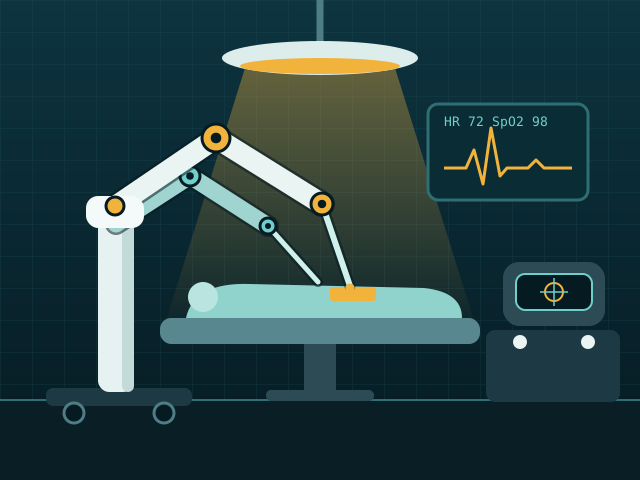
Illustration of a robotic-assisted operating theatre with a multi-arm robot, surgical light and surgeon console
Appraised against IEC 60601-1IEC 80601-2-77IEC 80601-2-78ISO 14971IEC 62304ISO 13482ISO 15189FDAEU MDRMFDS

Why advisory

The brochure and the ward rarely agree.

Robots are bought on best-case demonstrations. The decision that holds up in a budget review starts from your patients, your staff and your volumes.

CLAIM

Performance is not benefit

Many devices reach the market on technical performance. Patient-outcome and cost-effectiveness evidence arrives later, if it arrives.

COST

Capital is the small line

Service contracts, consumables, training time, integration and idle capacity usually decide whether a robot pays back.

ADOPTION

Workflow decides use

A robot that does not fit theatre lists, ward routines or clinician habits ends up as an expensive ornament.

ACCESS

Impact depends on who can use it

In public and resource-limited systems, affordability and referral reach matter as much as the trial result.

Who we work with

Four kinds of client, one method.

Hospital leadership

Boards and executives

A defensible business case before a multi-year capital and service commitment.

Clinical teams

Department heads

Evidence and workflow analysis for the robot your surgeons, therapists or lab leads want to adopt.

Public sector

Ministries, payers, procurement

Health-technology assessment, budget impact and access analysis for national and regional decisions.

Industry

Robotics companies

Clinical evidence planning, hospital-facing economic models and reimbursement positioning.

Four domains

Where robots meet the hospital.

Each domain has its own evidence base, its own cost drivers and its own way of failing. The appraisal follows the domain.

Close-up illustration of a surgical robot arm above an operating table

Surgical robotics

Will the console earn its place in your theatre?

Robot-assisted systems change operating time, length of stay, conversion rates and consumable spend. Which of those matter depends on your procedures, your surgeons and your annual case volume.

Questions we answer

  • How many cases a year does this system need to break even?
  • Which procedures show a patient benefit over laparoscopic or open surgery?
  • What does the team learning curve cost in theatre time?
IEC 80601-2-77IEC 60601-1ISO 14971FDAEU MDR
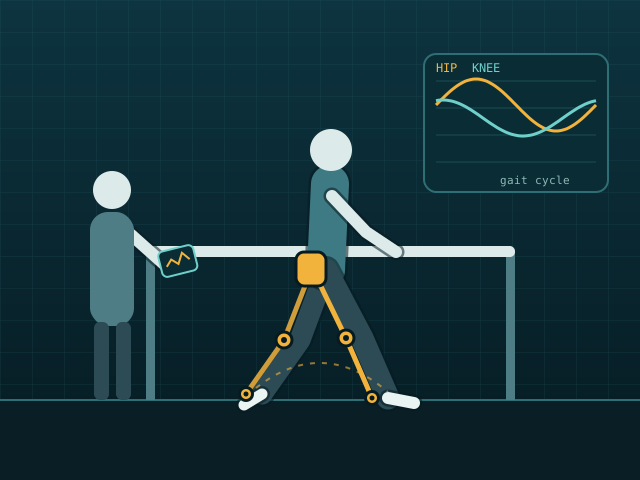
Illustration of a patient walking in a powered exoskeleton between parallel bars with a therapist and gait graph

Rehabilitation and assistive robots

Do more repetitions mean better recovery for your patients?

Exoskeletons, gait trainers, upper-limb robots and tele-rehabilitation can raise therapy dose and release therapist time. The gain depends on patient selection, session design and what your payer will fund.

Questions we answer

  • Which patient groups show a meaningful functional gain?
  • How much therapist time is released, and where does it go?
  • Is the device reimbursable, or does the hospital carry the cost?
IEC 80601-2-78ISO 13482ISO 14971IEC 62304
Illustration of a laboratory pipetting robot above a 96-well plate with a sample rack and analyser

Laboratory automation

Where does automation shorten turnaround, and where does it only move the bottleneck?

Liquid handling, pathology workflows and cell-processing platforms promise fewer errors and fewer staff hours. Test menu, sample volume, information-system integration and validation effort decide the return.

Questions we answer

  • What volume and test mix justify a workcell?
  • How long does validation take, and who does it?
  • What happens to turnaround and error rate during downtime?
ISO 15189IEC 61010-2-101EU IVDRIEC 62304
Illustration of an autonomous delivery robot travelling down a hospital corridor

Hospital logistics and automation

Which ward tasks can a robot take over without creating new ones?

Delivery robots, pharmacy automation, UV disinfection and patient-handling aids release staff hours only when they fit lifts, networks, infection-control rules and the way ward teams already work.

Questions we answer

  • How many staff hours are released, and who reclaims them?
  • Does it work with your lifts, Wi-Fi and building layout?
  • What is the fallback when it stops?
ISO 3691-4IEC 81001-5-1IEC 62304ISO 14971

The Robotingale method

Six lenses, one appraisal rose.

Florence Nightingale used polar-area diagrams to make evidence impossible to ignore. Every engagement ends with the same picture for your robot: what the brochure claims against what the appraisal supports.

  1. Frame the clinical need

    Define the patient problem, the current pathway and the outcome that has to move.

  2. Appraise the evidence

    Grade trials, registries and real-world data. Separate technical performance from patient benefit.

  3. Model the economics

    Budget impact, total cost of ownership, payback, break-even volume and, where relevant, cost per quality-adjusted life year. Every model carries sensitivity ranges.

  4. Design the pilot and governance

    Set the protocol, success thresholds, training plan and stop rules before the contract is signed.

  5. Track outcomes

    Compare results with the model at set intervals and adjust the plan.

Budget impactTotal cost of ownershipPayback periodBreak-even volumeICER / QALYSensitivity analysis
Appraisal roseSelect a wedge
Vendor claimIndependent appraisal

Illustrative example device. Scores are invented to show the format. Wedge area is proportional to score, as in Nightingale's diagrams.

Packages

Start free. Pay for the depth you need.

Fixed-fee engagements with a written scope. You know the deliverable and the price before work begins.

Free

Discovery call

Thirty minutes to describe the decision in front of you. You leave with the questions that matter and a clear view of whether a paid engagement makes sense.

Request a free call

Readiness Review

US$1,500Fixed fee · about 2 weeks

A focused review of one robot decision, ending in a written go, no-go or not-yet recommendation.

  • Evidence snapshot
  • First-pass economics
  • Six-page decision memo
  • 60-minute debrief
Request this package
Most requested

Business Case and Evidence Dossier

US$4,500Fixed fee · 4 to 6 weeks

A board-ready case with a graded evidence review, a full economic model and a risk and regulatory summary.

  • Economic model workbook
  • Evidence dossier
  • Board presentation
  • Two review calls
Request this package

Vendor Selection and Pilot Design

US$7,500Fixed fee · 6 to 8 weeks

Structured criteria, side-by-side vendor scoring and a pilot protocol with outcome thresholds.

  • Weighted scoring matrix
  • Clinical questions for the RFP
  • Pilot protocol and stop rules
  • KPI dashboard specification
Request this package

Advisory Retainer

US$2,000Per month · rolling

Ongoing access for hospital teams and robotics companies with several decisions or an evidence programme under way.

  • Up to 8 advisory hours a month
  • Priority turnaround
  • Quarterly review of outcomes
Request this package

Fees are indicative starting points in US dollars. Scope and price are confirmed in writing before work begins. Public institutions in low- and middle-income countries can ask about adjusted terms.

Questions

What clients ask first.

Are you independent of robot manufacturers?

Robotingale does not sell robots, resell equipment or take commission from manufacturers. Any commercial relationship that could affect an assessment is disclosed in writing before an engagement starts.

What do we receive at the end?

A written deliverable for each package: a memo, a dossier or a protocol. Economic work includes the working model, so your finance team can test every assumption.

Can you work with a small or public hospital on a tight budget?

Yes. In public and resource-limited settings, robot decisions turn on affordability and access as much as on outcomes. Both are built into the method.

We are a robotics company. Can you help?

Yes. Typical work covers clinical evidence planning, health-economic models for hospital buyers and payers, and reimbursement positioning. Robotingale will not write claims that the evidence does not support.

Do you give medical, legal or regulatory advice?

No. Robotingale provides advisory analysis on technology decisions. It does not give patient-specific medical advice, legal advice or prepare regulatory submissions. Regulatory findings summarise public status and standards and should be confirmed with your own regulatory counsel.

Which markets do you cover?

Engagements run remotely in English. Regulatory mapping covers the United States, the European Union, South Korea and Sri Lanka, with other markets on request.

Free consultation

Tell us which robot you are weighing.

A short description is enough. You will get a reply with a proposed time for a free thirty-minute call.

  1. 1You describe the decision, the setting and the deadline.
  2. 2We reply with a call time and the questions we will ask.
  3. 3After the call you decide whether a paid package fits.